
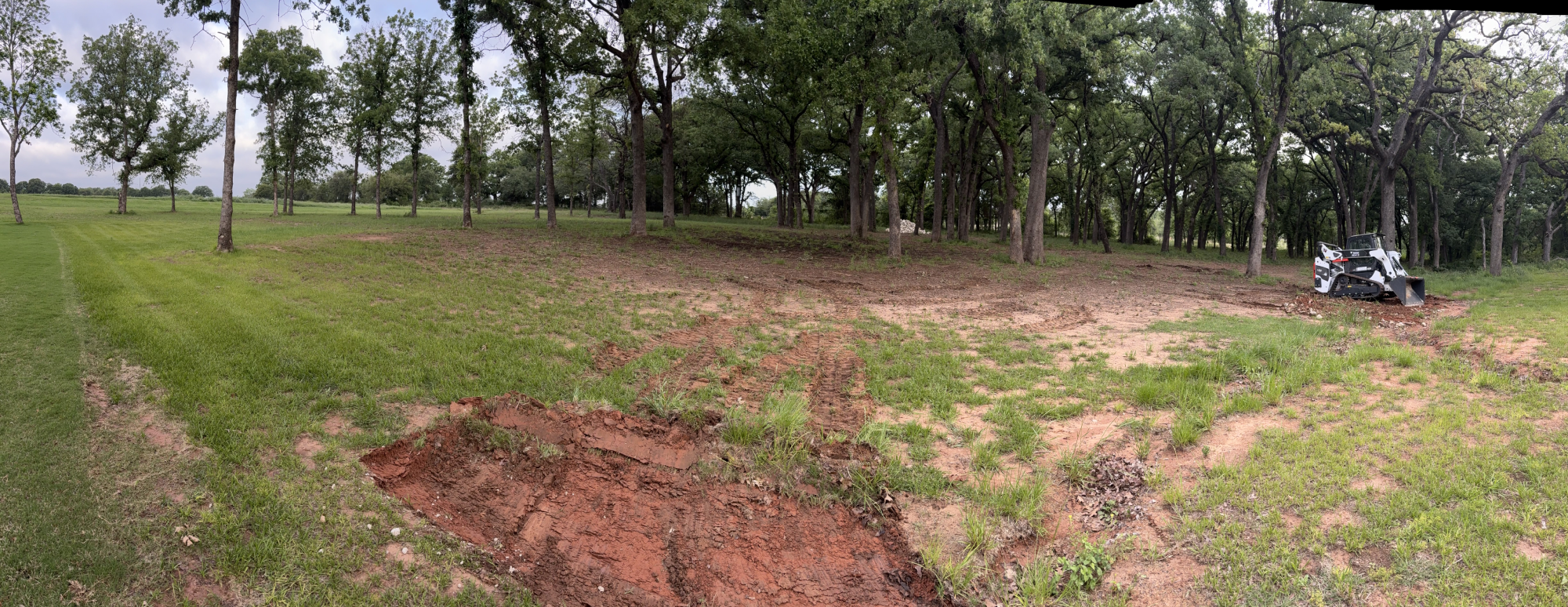
Forestry mulching is a land clearing method that grinds trees, brush, and vegetation into mulch in a single pass, using a machine-mounted cutting head instead of a blade or chains. It beats traditional bulldozing on most Hood County properties because it leaves no burn piles, disturbs less topsoil, and gets the job done in fewer visits. Here’s how it actually works and when it’s the right call.
If you’ve gotten quotes for clearing acreage near Granbury, you’ve probably heard “mulching” and “dozing” thrown around like they’re interchangeable. They’re not, and picking the wrong one can cost you an extra haul-off fee, a burn permit application, or a property that erodes the first time it rains hard.
What Forestry Mulching Actually Does
A forestry mulcher is a rotating cutting head, mounted on a skid steer, compact track loader, or excavator, packed with carbide teeth that shred standing vegetation into fine mulch on contact. Unlike a dozer, which pushes trees and brush into piles, a mulcher processes everything where it stands. The ground vegetation, brush, and small-to-medium trees get reduced to a layer of mulch that stays on the property instead of leaving in a dump truck.
Pro Tip: Ask any contractor quoting mulching work whether they’re running a drum head or a disc head. Drum heads produce a finer, more even mulch; disc heads move faster but leave a rougher finish. On a residential lot near a home, finer mulch usually looks better and breaks down faster.
How Forestry Mulching Compares to Traditional Clearing
| Factor | Forestry Mulching | Traditional Bulldozing |
| Debris handling | Stays on-site as mulch | Piled for burning or hauling |
| Topsoil disturbance | Minimal | Can be significant |
| Permits | Rarely required | Burn permit often needed |
| Best for | Brush, cedar, small-to-medium trees | Heavy timber, tap-rooted species, full grade prep |
| Typical pace | 2–4 acres/day (moderate brush) | Varies by equipment size |
Did you know the mulch layer left behind after clearing actually helps the property recover faster? It suppresses weed regrowth, holds moisture through the summer, and slowly breaks down into organic matter that supports native grass coming back in.
When Forestry Mulching Is the Right Call
Mulching is the better fit when a property has scattered cedar, brush, or vegetation that isn’t reliant on a deep tap root. That describes most of the overgrown acreage we see around Granbury and Hood County, where Ashe juniper (cedar) dominates the landscape and dies once it’s cut or ground up. Our land clearing services team defaults to mulching on the majority of residential and light commercial sites here for a simple reason: it’s usually both cheaper and less disruptive than the alternative, and for a full breakdown of what land clearing costs across different vegetation types, our guide on what land clearing actually costs in Hood County covers the full pricing picture.
When Traditional Clearing Still Wins
Mesquite is the exception that trips people up. It’s tap-rooted and resprouts from the root crown if it’s only mulched on the surface, which means mesquite-heavy properties usually need an excavator with a grubbing attachment to physically remove the root system. Heavy timber and very dense stands can also slow a mulcher down enough that a dozer becomes the more efficient choice, particularly on larger acreage where full-grade site prep is the end goal anyway.
A Cost-Share Program Worth Checking Before You Book
Mulching isn’t just a private-property decision. The USDA’s Environmental Quality Incentives Program (EQIP), administered through NRCS Texas, offers cost-share assistance for brush management practices, including mechanical mulching, when the work addresses resource concerns like erosion control or wildlife habitat improvement. It’s a competitive, application-based program, not a guaranteed rebate, but it’s worth a call to your local NRCS office before scheduling a large mulching project, especially if erosion or habitat conditions are part of what’s driving the clearing in the first place.
For landowners dealing specifically with cedar, Texas A&M AgriLife Extension’s cedar management guidance breaks down how Ashe juniper responds to different control methods, which is useful context if you’re deciding between full mulching and more targeted brush control on part of a property.
How Much Does Forestry Mulching Cost?
Pricing in Hood County generally runs $1,400 to $2,800 per acre for light to moderate brush, and $2,800 to $5,500 or more per acre for heavy cedar or dense stands. Density is the biggest factor. A pasture with scattered cedar clears fast and cheap; a property choked with mature cedar thickets takes longer and costs more, simply because the mulcher is processing more material per pass.
Did you know larger properties often see a lower per-acre rate? Mobilization, the cost of getting equipment on-site, stays roughly fixed regardless of acreage, so a twenty-acre job typically prices out lower per acre than a two-acre job with the same vegetation density.
How Long Does Forestry Mulching Take?
A mulcher on moderate brush covers two to four acres a day. Dense cedar, mesquite mixed in, or rough terrain slow that pace. A small residential lot might wrap up in a single day; a multi-acre ranch property with heavy brush can take a week or more. Weather matters too. Wet ground near creek beds or low-lying areas can push a schedule back, since tracked equipment performs best on firm, dry ground.
Frequently Asked Questions
Is forestry mulching better than bulldozing? For brush, cedar, and small-to-medium trees, yes, in most cases. Mulching skips burn piles and haul-off costs and causes less topsoil disturbance than bulldozing, especially on rocky Hood County ground.
How much does forestry mulching cost per acre? Expect $1,400–$2,800 per acre for light to moderate brush and $2,800–$5,500+ per acre for heavy cedar or dense stands. Mesquite-heavy sites often cost more due to added grubbing work.
Can forestry mulching remove tree stumps? Mulching grinds standing vegetation and small stumps at ground level, but it doesn’t remove root systems. Tap-rooted species like mesquite typically need excavator grubbing to prevent regrowth.
Does forestry mulching hurt the soil? No, it’s one of the least disruptive clearing methods available. Tracked equipment spreads weight evenly, and the mulch layer left behind protects topsoil and helps retain moisture.
How long does forestry mulching take on a few acres? A mulcher typically clears two to four acres per day on moderate brush. A five-acre property might take one to three days depending on vegetation density and terrain.
Ready to See If Mulching Fits Your Property?
Forestry mulching handles the majority of brush and cedar clearing jobs in Hood County faster, cheaper, and with less environmental disruption than traditional bulldozing. Mesquite-heavy or heavily timbered properties are the main exception, where a combination approach usually makes more sense.
The best way to know which method fits your property is a walk-through with someone who can look at the actual vegetation. Schedule a free on-site estimate, and we’ll tell you straight whether mulching, traditional clearing, or a mix of both is the right call for your acreage.